


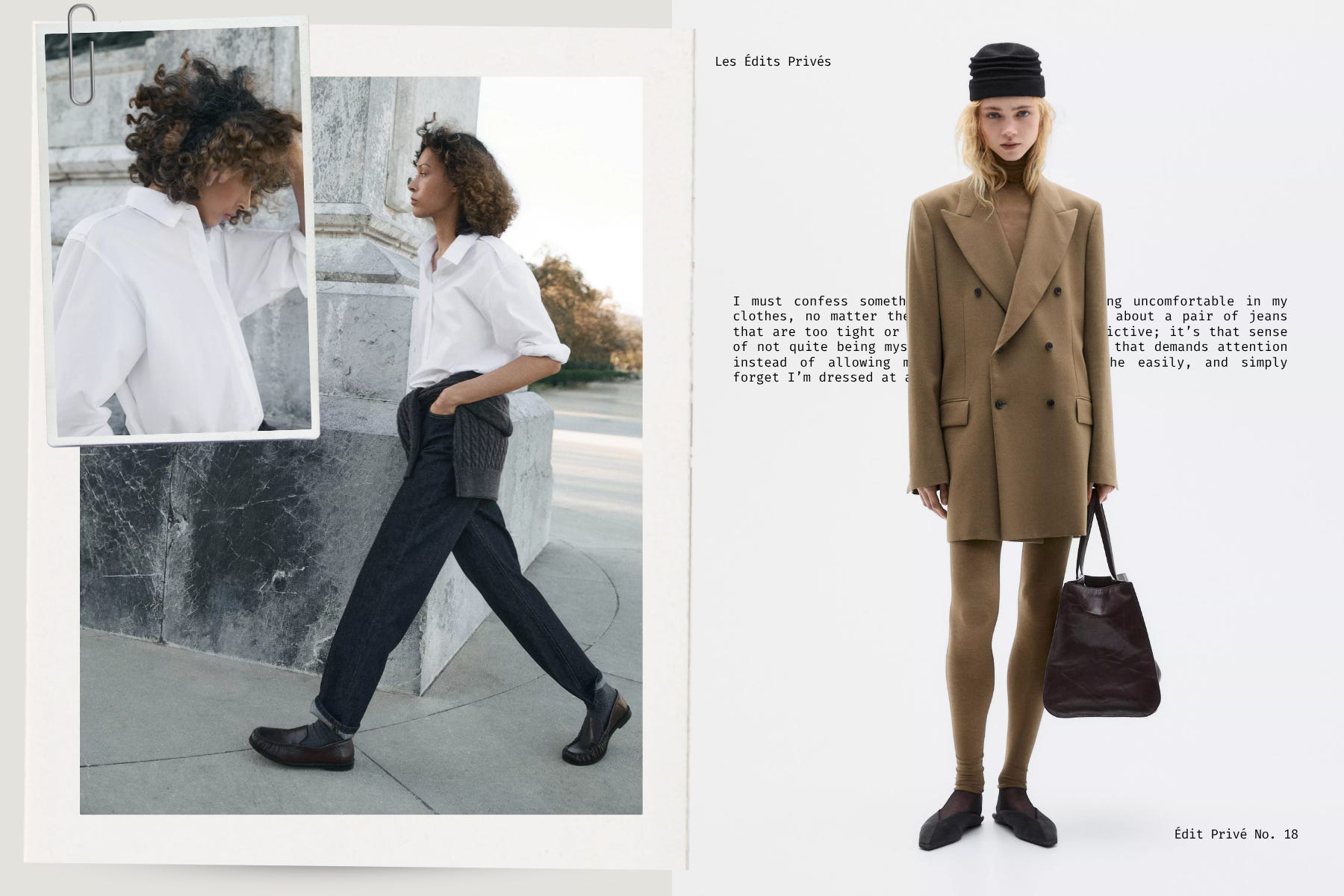
I must confess something: I can’t stand feeling uncomfortable in my clothes, no matter the occasion. It’s not just about a pair of jeans that are too tight or a jacket that feels restrictive; it’s that sense of not quite being myself, of wearing something that demands attention instead of allowing me to move freely, breathe easily, and simply forget I’m dressed at all. When that happens, all I want is to go home, change, and return to myself.
After seven years of writing about French and Parisian style, I’ve come to realise that comfort isn’t a compromise, it’s a form of elegance. It’s something I’ve long observed without naming: that moment when a woman looks so at ease in her clothes that you no longer notice what she’s wearing, only the confidence she radiates. There was never a single revelation, more a slow, gentle truth. Through seasons, runways, silhouettes, and my own trials before the mirror, I’ve learned that comfort, in French style, isn’t the opposite of chic, it’s the very heart of it.
When I think of this idea, one image always comes to mind: a woman who can do anything (walk, cycle, cross the city, stop at a café, attend a meeting or a dinner) without ever feeling overdressed or underdressed. That’s the kind of freedom I admire: an elegance that moves, adapts, and never performs.
And yet, I know how paradoxical this sounds today. We still tend to confuse comfort with carelessness, as if being well dressed must require a little suffering; as if simplicity were something bland. But true simplicity, the kind the French master, demands more thought, more intention, more refinement than we think.
So today, I’d like to share with you my own approach to comfort, the French way, from the perspective of an editor who works from home, who writes, who lives by bike (I live in Amsterdam), and who refuses the idea that one must dress up to look put-together. It’s a way of thinking about your wardrobe as a space of freedom.